


Introduction: Why Tabs Are the Ultimate GPS for Beginners
When beginners first look at a page of sheet music paired with traditional ocarina charts, they often feel intimidated—worrying that deciphering musical notes and complex dot patterns is like cracking a secret code.
Think of an ocarina tab not as a dry textbook, but as a visual GPS map of the musical terrain. Each filled and hollow dot on the diagram corresponds precisely to where your fingers should rest on your instrument. Once you learn how to read this map, you can effortlessly “draw” beautiful melodies with your fingertips, even without prior knowledge of traditional music theory.
1. Deconstructing Visual Codes: How Dots Map to the Musical Staff
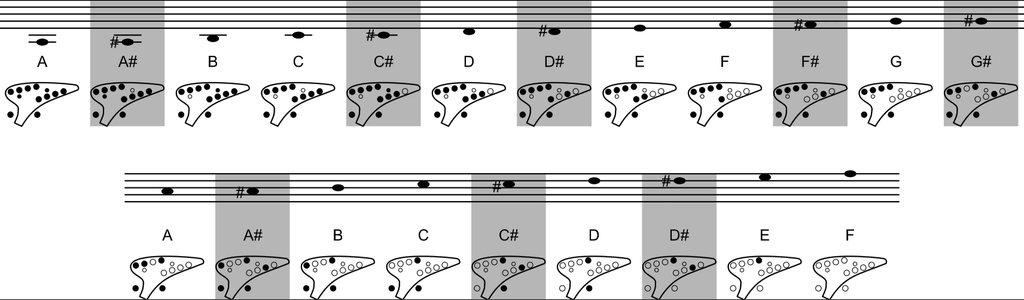
As clearly illustrated in standard ocarina fingering charts, the 12-hole ocarina follows an intuitive, linear progression:
- The Linear Progress of Pitch: Starting from the lowest note (A) on the bottom left, lifting your fingers one by one causes the pitch to rise step-by-step up the musical scale, all the way to the highest registers.
- Filled Dots vs. Hollow Circles:
- Black Dots (Closed Holes): Indicates tone holes that must be firmly and completely sealed with your finger pads.
- White Circles (Open Holes): Indicates holes that must remain uncovered to allow uninterrupted airflow.
- Shaded Zones & Accidentals (Sharps #): The shaded columns on the chart highlight accidental notes (such as A#, C#, D#, etc.). These are achieved through precise half-holing or specialized combination fingerings, allowing you to play in any musical key effortlessly.
2. From Mechanical Reading to Muscle Memory: Three Practice Steps
Transitioning from looking at a diagram to playing fluid music requires a systematic three-step approach:
- Static Finger Matching: Hold your 12-hole AC ocarina without blowing into it. Look at the tab and practice opening and closing the corresponding holes slowly, letting your hands adapt to the spatial layout.
- Single-Note Articulation & Breath Tuning: Play individual notes from the chart using a gentle, natural breath. Ensure that every closed hole is sealed airtight with zero buzzing or air leakage.
- Smooth Finger Transitions: Practice moving between adjacent fingerings slowly. Eliminate any finger stiffness or hesitation so your melody flows smoothly without sudden breaks.
3. Why Craftsmanship Matters for Ergonomic Fingerings
Reading a map is easy only when the roads are well-paved. The same applies to ocarinas: even the best fingering chart will fail if the instrument’s ergonomics are flawed.
Performance-grade 12-hole AC ocarinas feature scientifically proportioned hole spacings and meticulously beveled rims. This allows players of all hand sizes to cover the holes completely and comfortably, eliminating finger fatigue and accidental air leaks during fast-paced melodic passages.
Master Your Music Map Today
An ocarina tab is simply a friendly guide leading you into the boundless world of music. With a bit of practice, visual charts transform into effortless muscle memory, letting your emotions flow freely through your fingertips.
Ready to explore the full range of your instrument? Visit tonecraftho.com to download our comprehensive, high-resolution 12-Hole AC Ocarina Complete Fingering Chart (PDF), pair it with our step-by-step video tutorials, and start your musical journey today!